Revisit, Review, Revise–But Don’t Reverse History

Why a post about Thanksgiving in February? Well, my blog purports to address revisions of history: fictional stories that convey more truth than fact, genealogical accounts that shift the focus of history from huge international events to the simple truths of everyday lives of ordinary people, and non-fiction work that blows us away with new discoveries in history, in anthropology and DNA, in science and how we comprehend the world and the universe. I’d like to comment on a quintessential part of American history that is absolutely ripe for revisionists–and not for the better.

Here is my how-NOT-to-revise-history polemic.

I believe that re-writes of history are a constant, as we discover more facts and as we find it desirable to emphasize certain aspects of that history to further our interests and beliefs in the present day. No single interpretation of history is ever going to be flawless or final, but that doesn’t negate the necessity of examining the past in new ways–on the contrary, I heartily believe in and encourage the existence of several versions of history existing and circulating at any one time.

HOWEVER. Having said that, I don’t believe we need to allow free-for-all revisions of our heritage to suit the zeitgeist of any particular group. On the contrary, a modern sensitivity to a pluralist view of what history’s lessons are or should be should make us that much more critical and careful about being as truthful and honest as possible. We have an age-old problem wherein our cultural attempts to redress the wrongs of the past sometimes lead us to allow the formerly-repressed voice to assert anything at all it wants–perhaps motivated by guilt or ignorance or just not wanting to be left out of the protest/party happening out in the street.

How not to celebrate a Quatercentenary

The year 2020 approaches, and with it, a 400th year commemoration of the foundation of Plymouth Colony. Already we have groups–some of them with a seeming-stamp of “official approval”–completely in denial of the notable values practiced in this Colony (but rarely in any other early European settlement attempts) and attempting to subvert what it is we’ve always celebrated about Thanksgiving, turning it instead into a day or mourning (for atrocities against Native Americans) and vilifying people like Governor Bradford (come on, do you even know what he generally stood for?!) –Strange, I generally genuinely like people who attempt to “subvert” anything! And I’m usually the champion of the politically-correct–at least the original goals of PC, before it became the free-for-all I decry above.

It’s become apparent that groups such as Plymouth 400 don’t speak for me; this isn’t political correctness, it’s misguided (all right, even malicious) distortion of history. We have nothing to learn from either extreme’s version of history, particularly when the purveyors of such versions behave so badly in the present. (You’ll have to Google around for some of the incidents at play in and around Plymouth, Massachusetts.) And we have much to learn from a historical look at why Thanksgiving became and stayed a national holiday in the first place. Hint: it wasn’t actually about blithely giving thanks and throwing around pumpkins and turkey drumsticks.

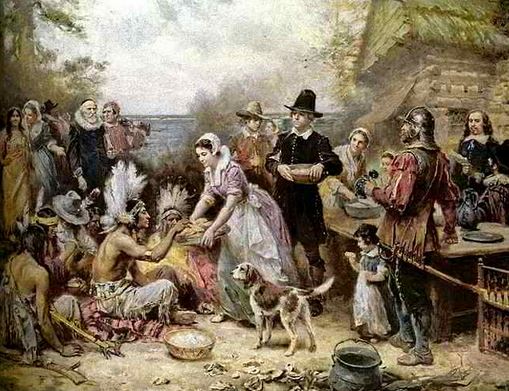
Give earlier Americans who selected Thanksgiving a worthy holiday some credit: we don’t celebrate Plymouth Colony because they were the earliest European colony; they weren’t. And we certainly don’t celebrate it because it epitomized white/native relations. Rather we still celebrate because it was the exception to the norm, an example of how integration should have been, and how it still could be if we only learn the lessons of history.

Why did the 1800’s “discover” the Thanksgiving holiday?

Remember, when the holiday was established and took hold later in the 1800s, our country was in the midst of increasingly ugly race relations; people knew it. Lincoln was responding to the ultimate human degradation, slavery. Out west whites were at war with Native Americans and atrocities were committed on both sides. The notion of genocide even became a possible vision for some. And often-violent prejudice met the most recent immigrants: Slavs, Chinese, Jews.

Given that backdrop we can see that celebrating the first Thanksgiving was NOT a quaint hypocrisy; it was a fervent wish by people weary with all the hate and violence that surrounded them.

Were there ulterior motives at play when Massasoit showed up with twice as many of his folks to the Plymouth colonists’ harvest bash? Sure, they wanted to let it be known they were watching. But hey, they brought food. Was there political maneuvering on both sides that first year, a search for alliances and allies? Of course, and that’s precisely the point: these people believed–and went on believing in spite of occasional individual mishaps–that this whole living-together thing could be accomplished without bloodshed.

Cut to the past century, as we continue not to learn the lessons from Plymouth Colony: Japanese interment, backlash against the latest immigrants, SE Asian or Hispanic or Muslim. . .You’d better believe I’m going to point out how ridiculous it is to equate Governor Bradford with the KKK or to turn Thanksgiving into a national day of mourning.

Well, given that there are some groups of people still fomenting dissent among the races, I guess I can see why they’re threatened by the vision of the First Thanksgivng after all.


Disclosure: I descend not only from Governor Wm. Bradford but also the mythological American love story, John Alden & Priscilla Mullins.
Disclaimer: I felt this way about Thanksgiving even before I found out I had ancestors on the Mayflower.


Reading suggestion:  Nathaniel Philbrick provides a good balanced example of all the voices preserved surrounding the impact of Plymouth Colony on the New World, and vice-versa:  2003. The Mayflower and the Pilgrims’ New World. G.P. Putnam’s Sons. That’s the young person’s version; I found it quite challenging enough!
1stTh

The Aphasic Horror – or, the Flip Side of Hypergraphia

When, literally, there are no words, there is no self.

Last time, I wrote about the phenomenon of hypergraphia as part of a collection of possible attributes that comprise Geschwind Syndrome, itself sometimes a feature of temporal lobe epilepsy. Having an over-abundance of words can be a wonderful “symptom” for a writer to have. But in my case TLE has on occasion led to a frightening, albeit brief, type of seizure producing aphasia: the complete loss of words. There are TLE seizures that are enjoyable when I’m given the leisure to entertain them: euphoria, dreamlike, dreaming-while-wide-awake, all-encompassing deja-vu states that hyper-stimulate both memory and creativity. But of all the unpleasant seizures that go along with TLE, none that I experience are anywhere near as horrible and frightening as the aphasia one.

I must be forgiven for complaining, because my seizures are relatively mild (and after Cymbalta was invented for my fibromyalgia I began to get quality sleep and the seizures have all but disappeared) and, being temporal lobe seizures, are usually undetectable to the outside world. But appearances most absolutely and certainly can be deceiving.
I know that the dreaded sensation I’m about to describe lasts probably only a second or even less, but believe me, it feels like an eternity while I’m “in” it.

It begins with a metaphorical “aphasia cattle prod” that hits me right between the eyes and it’s almost as if I’m being physically struck backwards; in the same moment my mind is wiped utterly blank. You can’t even imagine how blank. I suddenly have NO WORDS–none, nothing to think with. And the sensations are overwhelming: I feel as if I’m falling in total blackness, my hands clutching the air and finding nothing to hang onto, and with that/because of that I’m feeling utter terror, just about the worst terror I’ve ever known. (You can’t see me right now, but as I try to put myself back into that place, my hands are actually clawing at the air.)

During this eternity-moment I feel like I’m not even alive anymore; it feels as though I’ve been instantaneously relegated to a strange nether-world or limbo where life and death are the measure of nothing. I have no words so I can’t think! I may as well be a non-sentient slug in a petri dish. You can poke me and I might have an autonomic reaction, but I won’t be able to think about my past or my future or why I’m being poked. I can’t even think about thinking. I can’t think about myself as being apart from the petri dish or the poke or the pok-er or the pain. There is no form or structure for my consciousness; I’m not human when I have no words.

Of course my entire description of the experience is only possible in after-thought, and certainly what the experience is not occurs to me only as part of a sensation during the actual seizure. Falling and flailing in blackness and in terror is as much as I know at the time. It’s more than enough.

Afterwards I have a residual pressure (absence of pressure?) fogging me up right between and behind the eyes, a bit of fatigue after the aura, but a profound sense of relief to be standing on firm ground again. Sensory input flows through my mind again and the little talker in my head assigns what I experience words and descriptions and I exist once more.

The capacity for aphasia even for a moment scares the daylights out of me, and I can only begin to imagine the horror for people whose neurological impairments are more long-term. Oliver Sacks, the neurologist and writer, has described in multiple books some of the more strange and painful variations brain-damage can exhibit. There are more familiar conditions like Alzheimer’s, Parkinson’s, and the catatonic conditions seen in the film Awakenings, based on Dr. Sacks’ work. These are conditions which, like Geschwind Syndrome, can challenge one’s very definition of personhood and sense of self. I appreciate every day not being on that end of the spectrum.

So hard-wired wordiness aside, I honestly don’t take for granted that my reliance on words, my love of words, my very self-perception and definition through words is a given. Rather I know that it is a gift, this indicator of sentience and human-ness. I see words for the magic they are and I’ve understood for as long as I’ve used them the drive to tell stories with them, to make something that wasn’t there before I took pen to paper.

Aphasia

I’m hard-wired to be a writer? Whoa

hyperg-poster
Driven to write…

As it turns out, finding out you’re neurologically “hard-wired” to be a writer isn’t necessarily a good thing.

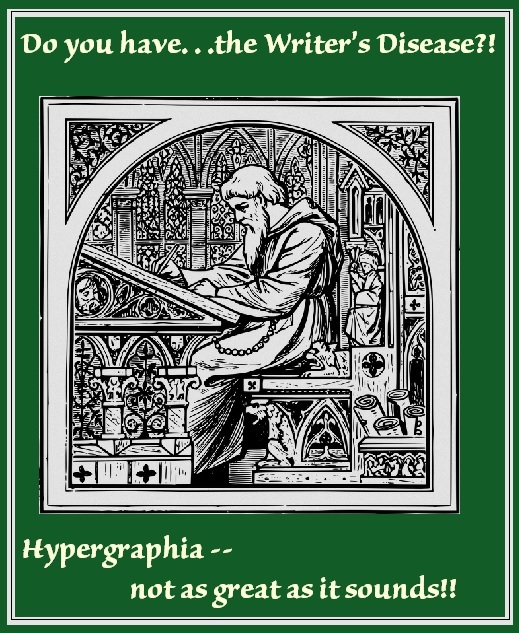
Hypergraphia, the urge to write excessively, is one of a cluster of characteristics forming Geschwind Syndrome, which is itself a personality-affecting phenomenon that often goes along with having TLE, or Temporal Lobe Epilepsy. Unlike better-known epilepsies affecting the motor-control areas of the brain, TLE influences the sensory-input processing part of the brain, also the part that controls language and memory access. (You may have heard how the “smell” part of the brain resides close to the “memory” part making smell one of the strongest senses that can evoke memory–well, TLE seizures can entail sensory hallucinations such as smell and complex deja-vu hallucinations.)

I had infant febrile seizures–they put me in a coma for about a day. But it wasn’t until about 15-20 years ago I began to learn about TLE and the fact that a scar on one or both of my temporal lobes had left its mark on my very personality for as long as I could remember. An obsession with language, the drive to write, a strong sense of social justice and the tendency to become mildly-obsessed with worlds of the imagination (cartoons, TV, movies, but most often books) could all be attributed to my neurological irregularities. I wrote stories and sometimes when I was too impatient to wait for inspiration I simply copied my favorite books from the library by hand. The thing with hypergraphia is, you want to write a lot; it isn’t necessarily good. Some people write loads of crap. Some who have little imagination just doodle their name all over everything.

But I tried to be a better writer. I began my first novel at age twelve, and by then was probably an even better artist than writer (abstract creativity sort of swirls out of Geschwind Syndrome and related conditions). I studied art in high school and AP English and French, then began a major in art and minor in music that resigned itself to a writing major and the music minor. This writing thing just wasn’t going away. I proved to be a pretty good abstract thinker and was sort of flattered into graduate school in Medieval/Renaissance literature. I adored Anglo-Saxon and the histories of Shakespeare–having already written quite a bit of political-themed stories myself.

By young adulthood, though, I began to be aware that my mini-obsessions, my intensely-curious and driven scholarship (and lack of interest in dating) and overly-developed “inner life” (I think Wikipedia calls it “intensified mental life”) was unusual, and there were some aspects of my routine I had to keep to myself. Color-coded notes and index cards, the tendency to live inside interesting stories and photographs, and always, always the story-writing. I figured it was just me. Er, that is, it is me. Only. . .IS IT?

This is the sinking-feeling reaction and subsequent specific despair that followed my diagnosis. It didn’t matter that I was in good company; many notable artists had TLE (Van Gogh, Dostoyevsky). So did many mystical saints and shamans–Joan of Arc. None of them were very happy in their personal lives, were they?! Destined to be misunderstood outsiders at best.

Far from being elated that I was quite literally hard-wired to be philosophical and detail-oriented and imaginative and a writer, I felt like my entire life of writing was. . .a symptom! It felt like everything that made me ME was simply a medical phenomenon. I walked around feeling like nothing more than a diagnosis. And though it wasn’t a conscious decision, I gradually. . .stopped writing. Whenever I looked at my latest novel I saw it the way a clinical scientist views experimental data: clear evidence of a mind gripped by disease. If I didn’t have a normal mind, how could my observations and opinions ever be valuable?!

And then what happened was, I became Not-A-Writer. For FIFTEEN YEARS. That was the extent of my despair. I had a degree in writing and a Master’s in literature; I had top grade-point averages and won every scholarship and assistantship and fellowship that had come my way. I wrote three doctoral degree comprehensive exams for twelve perfect scores and I had taught writing successfully at the college level for ten years–and still I somehow convinced myself it was all a fluke.

Of course the symptoms still found release during those years; I still told myself some pretty elaborate stories in my head. I had learned to compose and memorize scenes in my head verbatim since those days in high school when staying up late to get just one-last-thought written down became impractical, and I self-imposed a strict “lights-off” schedule. During the writing hiatus I had fantasies after lights-out as lengthy and complex and coherent as any novel I’d ever written–if not more-so because now I was conscious of the need for concise story-telling, since wordiness was a symptom of my “disease”. But I stubbornly refused to write any of it down. I silenced myself more effectively than childhood shyness or low self-esteem ever had.

Still, I read a lot, as many people do, and often I read novels that were okay but I said to myself, “This got published? I’m pretty sure I can do better than that.” Social media netted me some writer friends, then last November 2nd I learned about NaNoWriMo–the online challenge to write a novel in a month. Just draft it. And something about that challenge appealed to me and freed up my self-imposed writer’s block; no one had to see it, you just had to write it. For some reason the time was right and this was the thing that got my butt in the chair and really writing again. Finding the joy in writing again and not worrying about why. That is, I began to feel like a person again some time ago, I found my life, I continued to apply my talents researching and engaging my curiosity. But actually writing every day didn’t happen till last November.

So three months later I had a fairly coherent first draft of 144,000+ words and I guess the dam has burst, the die is cast, I’ve crossed the Rubicon et cetera. Laptops and the Internet writing community make for a very different world since last I was a writer. I don’t know where I’m going from here. But I don’t think I’m going to go quietly.


*Nothing in this post or the reading list should be construed as a basis for a medical diagnosis. If you suspect your symptoms go beyond those of your average neurotic head-in-the-clouds workaholic writer, go say “Hey” to the family doctor. She’s probably happy to see you ’cause it’s been awhile!

…Before my writing break-through, I have to say that I credit Oliver Sacks with finally making me feel human again. His writings about neurological-based disorders were the first I read that asserted his patients were human beings first and beyond any medical problems they may have. He has a belief in the transcendant wonder of life and the abilities of people, probably based in his faith. Alice Weaver Flaherty, furthermore, writes about hypergraphia as both a neurologist and a writer–and a patient.

Altogether this makes for a pretty fascinating beginner reading list:

Flaherty, Alice Weaver. 2005. The Midnight Disease: The Drive to Write, Writer’s Block, and the Creative Brain. Mariner Books.

Jameson, Kay Redfield. 1993. Touched With Fire (Manic-Depressive Illness and the Artistic Temperament). The Free Press/Simon & Schuster.

LaPlante, Eve. 1993. Seized (Temporal Lobe Epilepsy as a Medical, Historical, and Artistic Phenomenon). HarperCollins.

Ornstein, Robert. 1991. The Evolution of Consciousness (The Origins of the Way We Think). Touchstone/Simon & Schuster.

Sacks, Oliver. 1987. The Man Who Mistook His Wife for a Hat and Other Clinical Tales. Harper & Row.


A place from which to speak

This is not a blog (yet) so much as a place from which to speak:  comments made to other blogs, a location where I can be found.  At the moment I’d like to use this page simply to say “Hello” to a select few who may visit.

Hello.

When occasionally I find something to say here, I’m hoping for quality over quantity–not daily updates, not writing tips, but rather topics peripherally-related to writing that have engaged me for a few decades, and maybe will interest one of you.

I’m a researcher and a writer, in that order. I left graduate school a couple dozen years ago, but that was only ever the public version; in actuality the independent scholar never stops.  When folks tell me I should write more I protest:  But I’m still learning new things.

The notion of needing a specific field for research is an arbitrary tool–“you must choose a major”, “you must have a job title”. Those who have been curious for a few decades know that all so-called “fields” blend into one another.  What’s that ridiculous phrase, jack of all trades, master of none? Try me. There’s a much more solid aphorism:  you can’t see the forest for the trees. Well, no one appreciates a forest like I do. I’ve studied/taught ancient civ and the spectrum of creative writing, but also English Renaissance modes of historiography in drama and Anglo-Saxon riddles. I can make my studies of anthropology relate to my hobby of family genealogy.

I love language. I’m fascinated by the symbols scratched on a page that we give meaning. I love the way words come together to create something that wasn’t there before. I studied writing, then literature, then discovered that writings conveying history were a linguistic art form of their own.

Dissecting modes of historiography has informed my current fiction writing, because I believe this is a model for the kinds of critical thinking sorely lacking today.  But it’s also a way to appreciate poetic expression wherever it pops up — often in the most unlikely of places.  Literacy can be practiced on the classics, or utilized in reading political ads or blogs like this one.

We’re all telling our stories all the time. We may as well make them good ones.